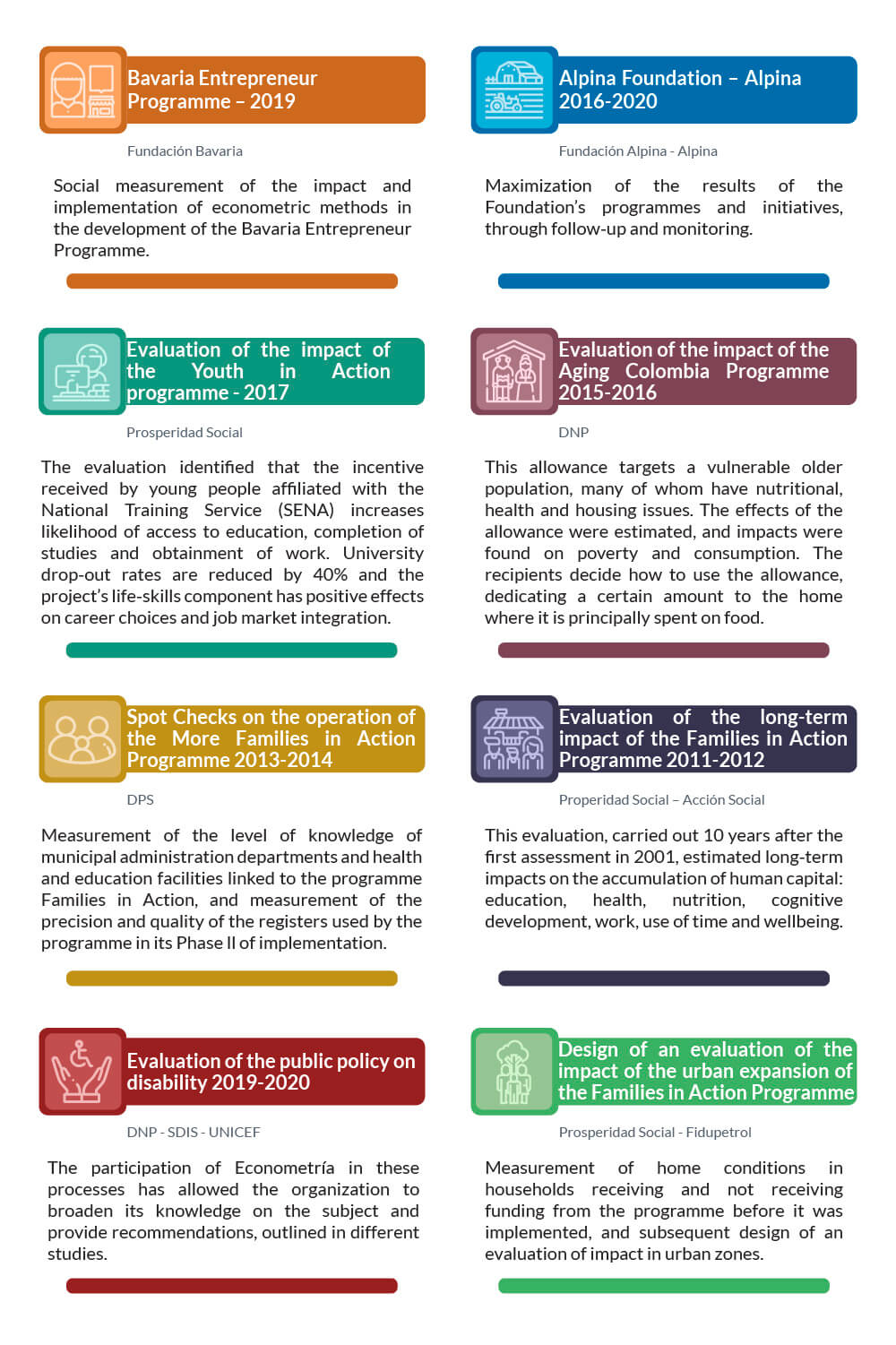
The most significant programmes and policies for inclusion in Colombia have been evaluated by Econometría, focused on the poorest people in the country. These policies of social inclusion seek to provide support to those in poverty through income support or conditional payments. This last form of income support is the most widely used strategy to support the poorest families and encourage the accumulation of human capital, characterized by money available on the condition of regular health and child development checks, and that children remain enrolled in full-time education. In Colombia the first such programme was Families in Action which began in 2001 and became in 2012 a permanent, national programme, protected by law and with an uptake of more than a million homes. Another conditional payment programme was Youth in Action, focused on encouraging young people to remain in higher education. Other programmes aimed at the vulnerable population are those of productive inclusion.
Our contribution
Econometría has participated in conditional payment transfer programmes since their implementation in 2001, and was responsible for the first evaluations of the impact of Families in Action and Youth in Action, in alliance with the Institute of Fiscal Studies (IFS) in London. The results of these evaluations had an impact on policy-making decisions regarding such programmes, focused as they are on the most vulnerable groups in the country. This experience has enabled our organization to make important contributions to other social inclusion projects within the public sector, as well as projects carried out by actors from the private sphere which are similarly focused on the country’s most vulnerable. Noteworthy in this last category are programmes of productive inclusion.
Our impact evaluation of conditional payment programmes has extended to other contexts, such as Honduras and the Bahamas. In Honduras an evaluation was conducted on the impact of a controlled randomization model for a Better Life Voucher, and in the Bahamas a baseline was designed and developed for the RISE programme.
Econometría has similarly evaluated programmes and policies of productive inclusion which seek to generate income for vulnerable groups, such as Women Who Save (Mujeres Ahorradoras) among other examples.
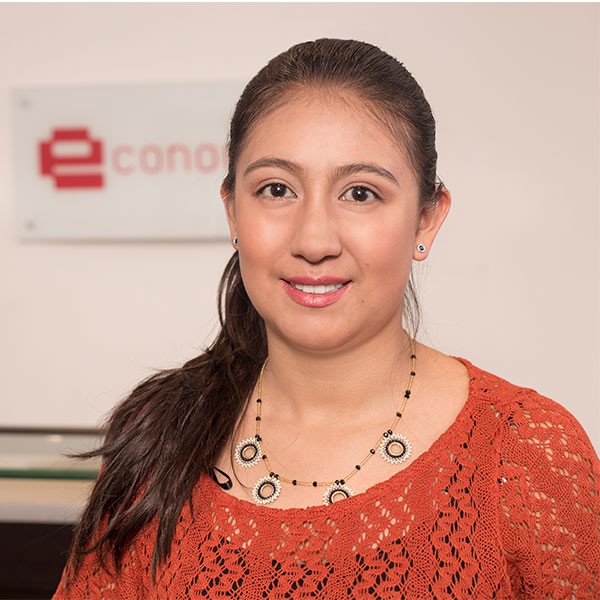
Maira Quiroz is a Finance professional, specialist in Finance, and holds a Master’s degree in Financial Management from Universidad EAFIT. She has been part of Econometría since 2015 and has experience in managing international operations, treasury, and financial analysis. Her interests focus on the management and optimization of corporate finance; the design of dynamic financial models aligned with the organization’s strategic planning; and transforming financial analysis into a decision‑making tool that provides strategic insight through execution monitoring.
Maira Quiroz
Financial Coordinator
Maira Quiroz is a Finance professional, specialist in Finance, and holds a Master’s degree in Financial Management from Universidad EAFIT. She has been part of Econometría since 2015 and has experience in managing international operations, treasury, and financial analysis. Her interests focus on the management and optimization of corporate finance; the design of dynamic financial models aligned with the organization’s strategic planning; and transforming financial analysis into a decision‑making tool that provides strategic insight through execution monitoring.
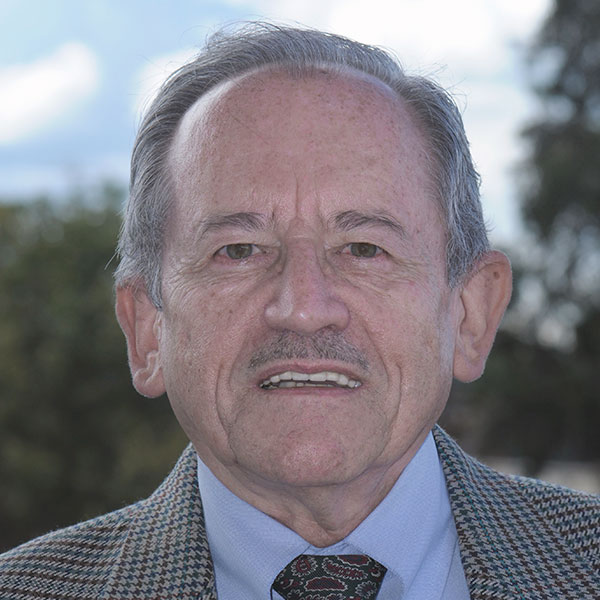
Rodolfo Heredia
Fundador
Rodolfo Heredia es Economista de la Universidad de los Andes (1965) y Demógrafo de la Escuela Woodrow Wilson de la Universidad de Princeton (1966). Tiene más de 30 años de experiencia en consultoría y estudios de desarrollo urbano, impacto social, socioeconómico, sociodemográfico, educación, empleo, salud, población, encuestas y análisis estadístico a nivel nacional.
Rodolfo Heredia
Fundador
Rodolfo Heredia es Economista de la Universidad de los Andes (1965) y Demógrafo de la Escuela Woodrow Wilson de la Universidad de Princeton (1966). Tiene más de 30 años de experiencia en consultoría y estudios de desarrollo urbano, impacto social, socioeconómico, sociodemográfico, educación, empleo, salud, población, encuestas y análisis estadístico a nivel nacional.
Bernardo Kugler
Fundador
Bernardo Kugler se graduó como Ingeniero Civil de la Universidad Nacional de Colombia en la promoción de 1962 e ingresó, recién graduado, como profesor de la Facultad. En 1977, se fundó la firma de Consultoría Económica llamada Econometría con el fin de emprender trabajos que contribuyesen a la solución de problemas específicos planteados por instituciones privadas o públicas. Fue el primer director de la firma, hasta 1979 tras haberse establecido su personería jurídica.
Bernardo Kugler
Fundador
Bernardo Kugler se graduó como Ingeniero Civil de la Universidad Nacional de Colombia en la promoción de 1962 e ingresó, recién graduado, como profesor de la Facultad. En 1977, se fundó la firma de Consultoría Económica llamada Econometría con el fin de emprender trabajos que contribuyesen a la solución de problemas específicos planteados por instituciones privadas o públicas. Fue el primer director de la firma, hasta 1979 tras haberse establecido su personería jurídica.